Cronus.
The fallen king
Cronus (Kronos): the Titan KingHe overthrew his father to rule the world. Then a prophecy made him fear his own children—and history repeated itself.
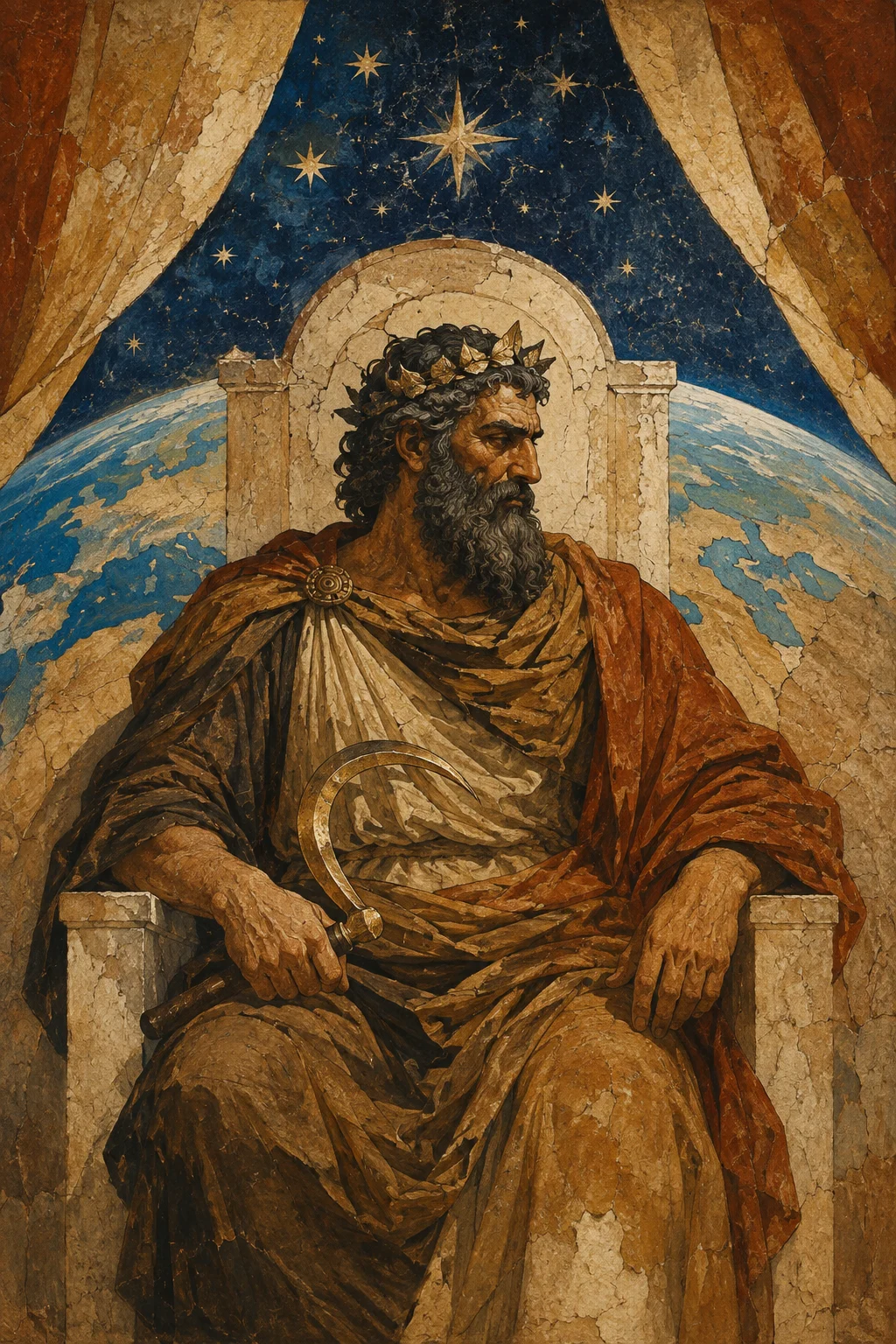
More than a myth.
The youngest son of and , dares to overthrow his father at Gaia’s urging. He rules with his sister , yet learns that one of his own children is destined to replace him. To prevent it, he swallows each child as soon as it is born.
saves their youngest, , by substituting a stone wrapped in swaddling clothes. When Zeus grows up, is forced to release his children, and a long war ends the rule of the . Later traditions connect his reign with a lost golden age, adding nostalgia to the story of a fearful ruler.
There’s more to the myth.
Lesser-known moments, places of worship, and stories that change with the storyteller. Follow each reference to the ancient voices behind it.
The king of a gentler age
’s places the golden human race under . Their life is free from the exhausting labor and misery of later ages. This generous remembered reign sits beside the frightening succession story in the ; ancient poetry preserves both portraits of the same ruler.
READ THE SOURCEHesiod, Works and Days 109 onwardBeyond the prison of the Titans
’s second ode associates with the blessed life beyond ordinary human suffering. This is a different horizon from permanent imprisonment in . His story therefore has more than one imaginable ending, depending on which ancient poem we follow.
READ THE SOURCEPindar, Olympian Ode 2.55 onwardCronus and Chronos
the and Chronos, the personification of time, are distinguishable figures whose names encouraged later associations. A sickle belongs securely to Cronus’s overthrow of ; an hourglass in a modern picture calls on a later visual language. Similar names should not erase differences between traditions.
READ THE SOURCETheoi: Cronus and the ancient interpretations of timeOne figure. Many visions.
Cronus, reimagined in 12 art styles. Follow familiar symbols through unfamiliar worlds, and open any artwork for a closer look.
Cronus
Echoes in Plaster
Cronus
Dreams of the Cosmos
Cronus
The Floating World
Cronus
Ink & Thunder
Cronus
The Gilded Garden
Cronus
Small Worlds, Great Myths
Cronus
A Cathedral of Light
Cronus
Blueprints of Myth
Cronus
Threads of Eternity
Cronus
Greek Myth, in Print
Cronus
Little Figures, Big Legends
Cronus
Beyond the Oracle
New AI-created interpretations, inspired by mythology. These are not images of ancient artifacts.
It’s a family affair.
Cronus
Titan kingship & successionthe and Chronos, personified time, are distinct figures, although later traditions sometimes connect them.
The stories of Cronus.
The war that made Olympus
Ten years. Two generations. One new world.
When the sea became beautiful
A goddess emerges from the aftermath of rebellion.
Before there was a world
An opening, an earth, and the first divine family.
Ancient voices.
Enduring stories.
Myths have many tellings. These are the ancient works behind this profile, linked to freely available English translations.
Theogony
Lines 137–187, 453–506
Library
Book 1.1–2
Explore the collected passages
Ancient testimonies, alternative versions and depictions, gathered by Theoi.