Aphrodite.
A force no god can resist
Aphrodite: Greek Goddess of LoveRising from the sea, brings desire into the divine world. Her power crosses every border, including the one between gods and mortals.
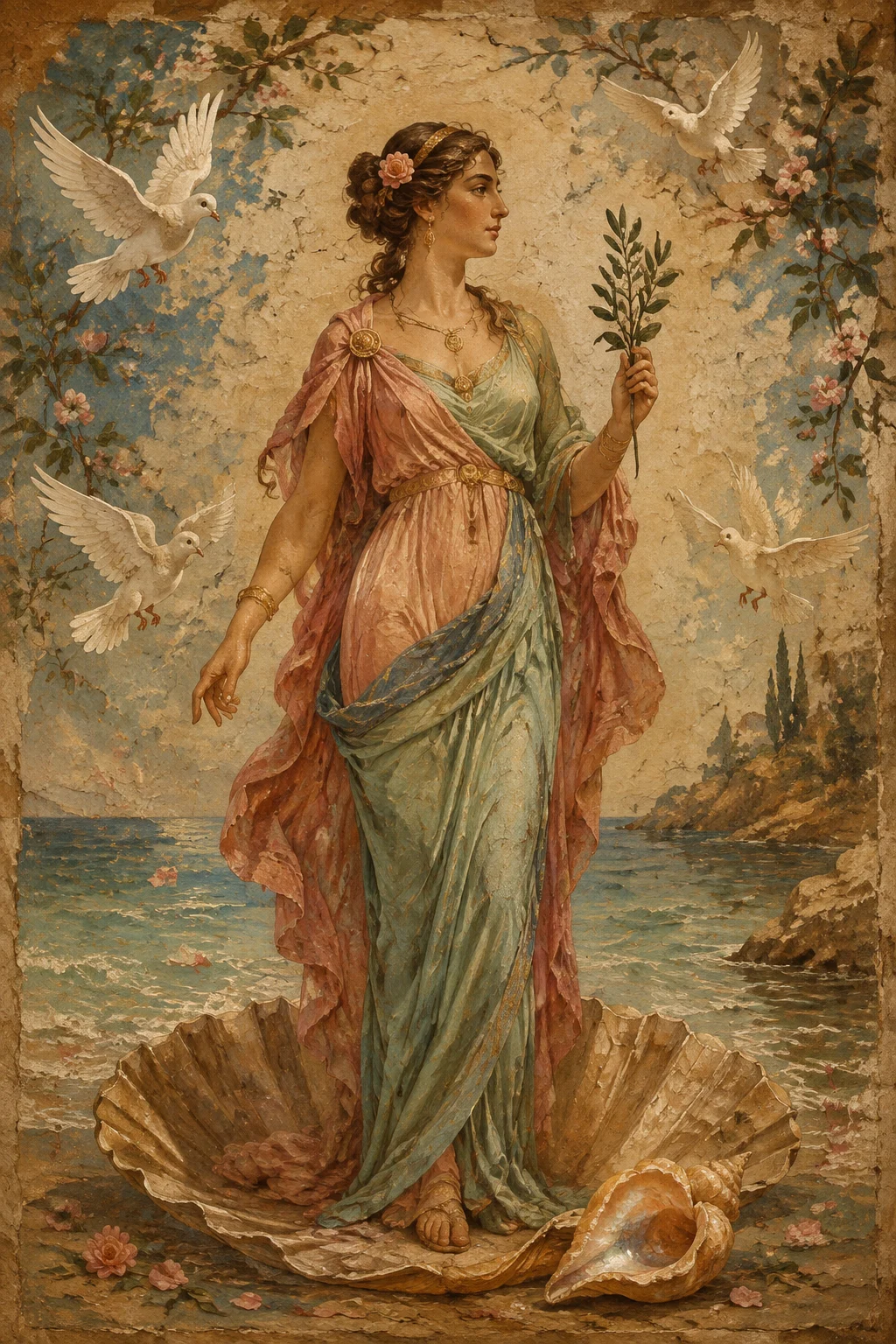
More than a myth.
tells that forms in the foam surrounding the severed flesh of and comes ashore near Cyprus. Homeric epic offers another , making her a daughter of and Dione. These accounts coexist rather than fitting neatly into one family tree.
The explores her ability to draw gods toward mortals and then reverses the pattern: makes her desire the Trojan Anchises. Their son is Aeneas. Her stories show beauty and desire as powers that can generate families, expose vulnerability, and set the course of wars.
There’s more to the myth.
Lesser-known moments, places of worship, and stories that change with the storyteller. Follow each reference to the ancient voices behind it.
Three hearts she cannot command
The fifth praises ’s influence over gods, people and animals, then names three exceptions: , and . also makes Aphrodite experience desire for a mortal herself. The poem explores both the reach of attraction and the limits on the goddess who ordinarily directs it.
READ THE SOURCEHomeric Hymn to Aphrodite 1–53The Hours dress the goddess
The sixth hymn brings across the sea to Cyprus, where the Hours welcome her with garments, a crown and jewelry before introducing her to the gods. The scene puts ceremonial dressing at the center of her appearance. Ancient poetry offers more than one visual starting point for her modern portraits.
READ THE SOURCEHomeric Hymn 6 to AphroditeTwo Aphrodites, two kinds of love
In ’s Symposium, the speaker distinguishes a heavenly , descended from , from another born to and Dione. He uses their to argue about the character of love. This is one participant’s philosophical construction, rather than a neutral explanation accepted by every ancient worshipper.
READ THE SOURCEPlato, Symposium 180d onwardOne figure. Many visions.
Aphrodite, reimagined in 12 art styles. Follow familiar symbols through unfamiliar worlds, and open any artwork for a closer look.
Aphrodite
Echoes in Plaster
Aphrodite
Dreams of the Cosmos
Aphrodite
The Floating World
Aphrodite
Ink & Thunder
Aphrodite
The Gilded Garden
Aphrodite
Small Worlds, Great Myths
Aphrodite
A Cathedral of Light
Aphrodite
Blueprints of Myth
Aphrodite
Threads of Eternity
Aphrodite
Greek Myth, in Print
Aphrodite
Little Figures, Big Legends
Aphrodite
Beyond the Oracle
New AI-created interpretations, inspired by mythology. These are not images of ancient artifacts.
It’s a family affair.
The graph follows ’s sea-born . In ’s she is the daughter of and Dione.
The stories of Aphrodite.
When the sea became beautiful
A goddess emerges from the aftermath of rebellion.
The fleece at the edge of the world
Jason reaches Colchis. Medea makes the impossible tasks possible.
The jar that changed human life
Pandora arrives bearing divine gifts and an opening no one can undo.
The apple that set a war in motion
Paris judges three goddesses, and a private reward becomes a public disaster.
Three apples and a race
Atalanta sets the terms of marriage. Hippomenes asks a goddess to change the odds.
The lamp that changed everything
An unseen husband. Four impossible tasks. A love brought into daylight.
Ancient voices.
Enduring stories.
Myths have many tellings. These are the ancient works behind this profile, linked to freely available English translations.
Theogony
Lines 188–206
Hymn to Aphrodite
Hymn 5
Explore the collected passages
Ancient testimonies, alternative versions and depictions, gathered by Theoi.